"What school?" The man at the bus stop is talking to me. Apparently he overheard my cell phone discussion of fall semester's return.
"CSUN."
"Northridge, heh. You know the stadium there, close to Devonshire and Zelzah? We carved our names into this big oak tree back in '76, but they cut it down."
"Oh."
"Yeah. I ran cross country for Granada Hills High School under Coach Godfrey. He was tough, man. He really worked you, but he was good. They won 16 city championships."
"Oh Wow! So did you go to the state championship?"
"Some guys went, but you know that costs money. I didn't have the dough to go." He rubs his fingers together indicating "no bills."
"Ah, I see."
Looking at him now, despite his age and the fact that he is dragging the last puffs from a cigarette butt, you could see the long distance runner in him. In fact, he likely covered the same distance today, only now he did it with an overstuffed canvas backpack and bedroll tied atop, causing him to lean slightly forward. This meant he could not reach the speed of his youth, but he was in a different category of competition these days.
A layer of grime, commonly found on outdoor furniture in the city of smog, covered him from his long graying hair to his frayed sneakers. A long bushy beard reminded me of John Muir. Here he was trekking through San Fernando Valley, just as Muir had trekked through Yosemite, telling the world of its beauty. His skin, where exposed, was wrinkled and red from the sun. Living on the street had made him deeply attuned to L.A. design trends: his jeans had wide torn holes to expose his lobster like kneecaps.
Back in the 1950s, when young people began wearing blue jeans, it was to show solidarity with the struggling worker, so one wonders if the current fashion of wearing ripped jeans shows solidarity with the struggling street person. Maybe if these kids met this friendly conservationist of the twenty first century, he would inspire them by his creative fight for urban sustainability. The tear that rips across the denim thigh could signal the desire to tear apart the concrete that now kills the Los Angeles River. Reviving this waterway, a long battle engaged in by Friends of the Los Angeles River, would be a small but vital part of returning wilderness to San Fernando Valley. Another would be to have Jennifer Anniston, born in Sherman Oaks, return to the valley, and take her Chip and Peppers for a walk.
Monday, August 28, 2006


Monday, August 21, 2006
corn pops

One day when dad was a farmboy in southeastern Iowa, he noticed a big owl was falling silently into the chicken pen, piercing its claws into the necks of White Leghorns and Rhode Island Reds and snatching them for lunch. So he takes a chicken carcass and sets up a simple cage trap. When the owl went to grab the flesh, the cage would fall on it. As planned, the next day dad finds the big bird knocking its wings hopelessly inside the cage wires. Carefully, dad lifts up the cage and knocks the bird on its head with a big rock. Proud as a boy coming home with straight A's on his report card, he runs to tell grandma.
"Ma! I caught that owl that was stealin' our chickens. Come and see!"
"What? No. I don't want to see that."
Undeterred, dad decides to bring the dead owl to the door for grandma to see. But when he returns to where he left it, the cage is missing. That was one strong owl. Apparently it had only been knocked unconscious and had crawled off with the cage. Fortunately, it couldn't crawl far, so dad finds it and this time knocks the big head really hard 'til that owl is good and dead. He ties a rope around its neck and drags it to the door to show grandma.
"Ma! Look, I have the owl right outside the door!"
Grandma, a small but tough woman, daughter of Swedish immigrants, is scornful.
"What'd you do that for? Huh? What'd you go and kill that owl for?"
"But," dad says defensively, "it was killin' our chickens!"
There aren't too many wild birds left in Iowa, which is now the most industrialized state in the nation. This artificial landscape, revealed by Michael Pollan in his book The Omnivore's Dilemma, emerged from the systematic destruction of biodiversity and the creation of processed food's Hiroshima: corn fields.
The environmental disaster called Iowa came to mind when I recently learned of the new trend among Silver Lake hipsters to have classic Mercedes converted to run on biofuel. The enthusiasm for biofuel cars emerges from the same junior high school reasoning responsible for the electric and hybrid vehicle cultists. Perhaps the myth of the frontier farmer transforming the wilderness into fertile land through individual smarts and effort runs so deep that recognizing ecological interconnectivity would spark anomic suicide in numbers unmatched since Jonestown--and people just don't yearn for Kool-Aid like they used to.
Of course, "pioneer" is just another word for "genocide" and until you grow and process corn based fuel in your back yard using nothing but sunlight, it is NOT "eco-friendly".
Sunday, August 13, 2006
Pedal to the Mettle

I used to be a bike rider. In Tempe I discovered biking in hundred degree heat was better than getting broiled by the sun at bus stops with little shade.
Monterey was a great biking city. I lived several miles from the nearest laundromat, so I would bike with a duffle bag full of dirty clothes balanced precariously on my front handle bars. The funny looks I received were compensated by the sights and sounds of sea lions found on the path between the wharf and Cannery Row. This path was the same one I rode on the way to the Pacific Grove Trader Joe's--up a mile long hill with at points a 40 degree incline. In the lowest gear of my rusted 3 speed a whining sound made me fear busting the bottom bracket, so I'd hop off and walk it up the steepest points. On the way down I tried to remember to tighten the little bolt on my pedal brake that stopped my foot from spinning free, being dragged to the asphalt, multiple broken digits and torn skin, as I pressed back trying to slow my jet like decline.
But now I walk to Trader Joe's just a few blocks down the street and bike riders annoy me.
They don't annoy me when they are in the street, but too often they buzz by me on the sidewalk--like just now at the Sepulveda and Ventura bus stop a guy with a black motorcycle helmet on a mountain bike. Why is he on the sidewalk? Because biking down a busy street like Ventura requires a certain madness. A madness of youth, like that of my cousin who I remember hitting a hundred as we drove a shortcut to the Quad Cities in his '70 Chevelle SS--a two lane road with one lane gravel and the other paved, so that coming and going we used the same lane and expected to avoid head-on collision by noticing the faint shine of headlights rising over the next hill.
Youth today have no problem launching their bikes down a half dozen stairs without helmet, but they fear biking down the side of Ventura like a serial killer. Which in a way it is since over 800 bicyclists are killed by cars each year.
Not all bike riders are kids looking to be the next the next Kevin Robinson. In fact, many are dishwashers and construction workers pedaling on Huffy's with squeaky chains in their aprons and steel toe boots because biking is even cheaper than the bus.
The answer to the clash of the carless--pedestrian vs. bicyclist--is of course bike lanes. But this is no San Francisco where a Critical Mass of bike riders began demanding the right to street space back in the early nineties with monthly rides where hundreds pedaled unpredictably through the streets, causing motorists heads to turn red with frustration until steam whistled out of their ears. The movement spread to cities across the country, and this month--Friday, August 25--bikers can help remind the world of the crime called Katrina, by hitting the streets for its anniversary.
L.A. has a few pedaling protesters. A group called CICLE fights for the bicyclists right to the road, and there are monthly rides in downtown, West L.A., Pasadena and Santa Monica--although notably none in the Valley. But the weakness of these rides reveals this city's dirty truth: it survives on nicotine fumes pumping through the lungs. Bike lanes would be putting filters on our Pall Malls, and what's the point if I can't taste the smoke?
Monday, August 07, 2006
O Superman
Superman, the man of steel, is in his seventies and living in Reseda, where I saw him get on the bus the other day. He's a little smaller than you might guess, about 5'6", and his skin sags somewhat. But his calves are still well defined, indicating the strength of his superhero days.
He's abandoned the Clark Kent disguise of a suit and tie journalist for the casual look of a retiree. He wears a white pocket T-shirt with a pullover tied around his waist and maroon hiking shorts. On his head is a baseball cap with a red bill, and on top of the cap is a white winter stocking hat. One might think this an unusual choice in the Valley heat, but perhaps it provides special protection for aliens. On the hat is a series of numbers written with a marker, a code that only secret agents understand.
Most other-worldly are his dark glasses. They appear to be the same horn rimmed frames of the past, but they are completely covered with tiny pieces of cellophane tape. It's as if he began to repair them at the corners or the nose bridge--as one often sees--and just kept layering piece after piece until he had transformed his frames into a mosaic by the most skilled of Italian artisans.

(Detail of arch mosaic from the mausoleum of Galla Placida, Ravenna from Furman University Classics Department.)
After sitting down he takes a rolled up plastic grocery bag from his pocket. Carefully, he opens it up to reveal a rectangle of aluminum foil. What? Is Superman selling crack? He unfolds the foil and inside is a row of neatly stacked coins. He thinks it over, chooses a few coins, places them back in their stacks, and chooses again. He folds back the foil, rolls it into the plastic bag and puts it back in his pocket. Finally, he slowly walks to the front and pays his fare.
Allan Kaprow, who passed away in April, introduced the concept of "Happenings" in the late 1950s. In distinguishing Avant Garde Lifelike Art from Artlike Art he wrote:
Avantgarde lifelike art is not nearly as serious as avantgarde artlike art. Often it is quite humorous. It isn't very interested in the great Western tradition either, since it tends to mix things up: body with mind, individual with people in general, civilization with nature, and so on.
--"The Real Experiment." Artforum 22: 4 (1983)
Superman always had an important role in the genealogy of performance art. One finds him in "Shoot" by Chris Burden, the flying flesh of Stelarc and of course the music of Laurie Anderson. In his golden age of the 1940s Superman boisterously fought metropolitan moral decline in a cape and blue tights with his farm boy values. He leveled "slums" so they could be replaced by decent housing--thus echoing the Federal Housing Acts of the 1930s and 40s. In the end these Acts reflected the powerful and racist interests of the National Association of Real Estate Boards, which preferred federally subsidized white home ownership in the suburbs to urban housing for the benefit of all.
Superman's sadness at these failures is evident. But there is quiet poetry in the mystery of his contemporary performance.
Monday, July 31, 2006
Speed Kills

Someone stole my moped. A 2005 Tomos ST, it had less than 200 miles on it. I was too greedy for speed.
I bought my first moped last summer. A 1986 Tomos "Golden Bullet," it ran great. On a level road I could hit 35 mph, but I got tired of putt-putting up hills at under 15. So in April I traded in for more torque.
It was great for bopping about the Valley when I needed to get somewhere fast although I had to endure horns blaring from frantic Wiley Coyotes enraged at me for once again foiling their attempts to catch the Roadrunner. Equally common, I provided a source for male bonding ridicule. One time while riding down Victory in Woodland Hills, two guys with long hair and tobacco stained teeth pulled beside me in a Chevy Suburban with jacked up struts and Raiders miscellany in every window.
"Hey You!"
I try to ignore them as they laugh.
"Hey you! Where you from West Hollywood? How fast does that go? Wanna race?"
"This gets a hundred miles a gallon. How much does it cost you to fill up?" I ask.
"At least we can afford it!" He replies.
"It doesn't look like it." I later think to reply. L'occasion perdu. For a couple of potheads, they sure had quick wits.
Riding a moped in L.A. gathers almost as much scorn as riding the bus. In European cities where Mini Coopers crawl through crowded streets averaging under 30, a moped is a jack russell terrier weaving through an agility course. In U.S. cities, designed for young men in their F150s to barrel by at 55, that jack russell is just hoping to escape being the next clump of flesh and fur, turning to dust in the crevice of a curb.
For a brief time in the 1970s, when the cost of gas first took a spike, there was a moped craze and multiple makers to choose from. Today most people confuse mopeds with scooters, and the only maker left in the U.S. is Tomos.
Since then urban flight became suburban flight, as every American family sought its divine right to a mowable lawn, and commuting to the new developments in exurbia became a three hour tour.
No I don't plan on buying a new one. The thief sent me a clear message: stick to the bus. More importantly, I didn't have comprehensive insurance, and I can't spare one month's rent.
Monday, July 24, 2006
Meth Mouth
Woodland Hills hit a record 119 degrees on Saturday, and I was there. The 150 Ventura line broke down at Corbin.
"Can't go any further." The driver says casually. "It overheated."
"What if you let it rest and try again?" asks a woman in her 70s.
"Well, do you want to wait an hour?"
Ironically, I was waiting for the 750 express but hopped on the 150 because it came first. Now I am five blocks from the nearest express stop at Winnetka. I step out into the full sun, and as I walk there I feel strangely fine. This isn't so bad. But when I arrive at the bus shelter and sit down, my forehead becomes a fountain of sweat. I look down to see a dark circle spreading from my belly as if I've caught shrapnel in the gut.
Meanwhile, due to storm caused power outages, the Southern Illinois district of John Shimkus slogs in the heat without even a fan to cut the steam, making a comment by his colleague on the House Energy and Commerce Committee tragicomic. After a hearing on the so-called "hockey stick" increase in global temperature, Michael Burgess, representative for suburban Dallas states, "It's false to presume that a consensus today - exists today where the human activity has been proven to cause global warming, and that's the crux of this hearing. I would point out that simply turning off the electrical generation plants that provide the air conditioning back in my district would not be a viable option."
One wonders how the native people survived for thousands of years without electricity and millions in the global south continue to live without it. If these white people can't handle the climate, why don't they go back to where they came from?
The equivalent of a bad SNL sketch, chaired by oil company consultant/stooge Joe Barton, the hearing brought in a statistician to question the minutiae of mathematical methodology that created a particular graph. Of course, the committee failed to invite the author of the report being questioned since lively debate is a threat to evangelocracy.
Not surprisingly, the oil sucking pundnuts have leaped on this statistician and started peddling his study as a way to keep humping the earth dry. These "rocks for jocks" flunkies ignore the broader point the study makes that the overall claims of global warming theorists are quite on target. One felt somewhat sad for this number cruncher Wegman from George Mason University when Representative Jan Schakowsky asked him a question about the role of carbon dioxide in warming the atmosphere:
Prof. WEGMAN: Carbon dioxide is heavier than air. Where it sits in the atmospheric profile, I don't know. I'm not an atmospheric scientist to know that. But presumably, if the atmospheric - if the carbon dioxide is close to the surface of the earth, it's not reflecting a lot of infrared back.
Representative JAN SCHAKOWSKY (Democrat, Illinois): But you're not clearly qualified to...
Prof. WEGMAN: No, of course not.
Rep. SCHAKOWSKY: ...comment on that.
Still Barton smiled triumphantly like a proud parent who just saw his son mumble through an elementary school performance of Goldilocks and the Three Bears.
These guys have the minds of meth dealers, the drug of choice in rural Republican heartland--electric power pushers--telling addicts they have a beautiful smile as they watch their teeth rot to black.

(Frontline map of meth's spread across the U.S.)
On the way back from Target, all the breakdowns transform what normally would be at most an hour long trip into an afternoon Journey, whose 1981 hit became an anthem for the 2005 World Series Champion White Sox:
"Just a small town girl, livin in a lonely world
She took the midnight train goin anywhere...
Dont stop believin
Hold on to the feelin
Yaaaaa!"
Monday, July 17, 2006
The Heat is On
"Sprawl is good." That's the essence of Robert Bruegmann's July 9 editorial in the L.A. Times, justly ridiculed by fellow valley blogger Andrew. Yet Bruegmann's assessment of L.A. history is dead on. Drivers universally embraced plans for a freeway city, imagining it would transform their cars into personal jet planes. It is no coincidence the Jetsons emerged when Interstate construction was at its peak.

(Image from Van Eaton Galleries)
Back in '99 when I lived in a deep frier called Tempe, Arizona, I saw Bruegmann speak at the Phoenix Public Library--an architectural jewel amid a downtown of shattered forty ouncers and crushed potato chip bags. Jaws dropped in the audience of architecture students, as if they had come to church and heard a sermon explaining how Jesus taught "Greed is good" and "If your enemy slaps you, kick him back hard in the balls."
His slideshow contrasted postwar housing in Europe--drab modernist apartment buildings--with postwar housing in the United States--single family homes with attached garages. The point was simple: sprawl is good because any normal person would choose postwar U.S.A. If you could choose between a McDonald's "premium" chicken salad and an Outback Steakhouse Steak, naturally you would choose the steak.
Americans love their beef, even if it means our flabby beef eating bodies consume more than a third of the world's resources and per capita more than three times the global average. Of course the apartment living losers in NYC, the ones who somehow survive outside suburbatopia, are not responsible for this piggishness. As pointed out in the beautifully photographed new series from PBS, design e2, the dense transit dominated city makes its residents the skinflints of America.
I was reminded of this recently as temperatures in the valley topped 100, causing peak rates of consumption and scattered blackouts in the L.A. area. I wondered how we lived without air conditioning? So I try. By using a thermometer measuring indoor and outdoor temperature, I keep track of when it is warmer inside than out and vice versa. In the morning, as soon as I notice the temperature is warmer outside, I shut all windows and close all the blinds. At night, when the temperature becomes cooler outside, I open all the windows and turn on the fan, repeating the process each day.
Of course, the real alternative to cranking the AC is relaxing in the park under the canopy of trees or having an espresso at the local café--but that sounds so European--why don't we just grab a Frappuccino® and head down to Zuma in your new Honda Element?
--Yeah, just like in that TV ad, man those chicks are hot!
--Yeah, just like the baby chicks dad fed the hogs when Tyson killed the independent chicken farmer and raising fryers became an economic loss.
--What?
--Yeah, just like that.
Wednesday, July 12, 2006
Rule 3
Pay attention to the ring of the stop signal. Once someone has pulled the cord, the signal will not sound if pulled again. Usually the sign above the windshield will say "stop requested," but sometimes this is broken. If you are really worried about missing your stop, politely ask the driver, "Has the next stop been rung?", and if s/he says no, gently pull the cord.
Above all, if the bell does not ring after you have pulled the cord, do not pull harder and harder. It doesn't help!
What a sad sight it is to see everyone from a spiky haired punk to a 70 year old women with groceries on her lap jerking the cable as if it's an emergency brake and we are hopelessly barreling toward a fireworks factory.
This is why you occasionally reach to pull the cable only to grasp air--like the Southern Steelhead Trout drained of its habitat by our suburban lifestyle--a signal cable can only take so much abuse before it dies.
Don't panic, recalling skills honed on the playground playing TV tag, dive to the other side of the bus and with your long finger give the cable a quick tug. Or if you are out of shape from too many years of drive through moments, just ask someone on the other side of the bus to do it for you.
Thursday, July 06, 2006
Tigger

"If I was married to her I would slit my throat." He draws his hand dramatically across his neck, apparently referring to a homeless woman resting at the bus shelter. The redheaded man is sitting behind the driver with one arm stretched across the seats as I step on the bus. He seems engaged in a conversation with other passengers, but I quickly realize it is more the performance of a bad stand-up comic, with an audience that squirms and grimaces rather than laughs.
As I head to a seat near the back, he continues his routine, accented by rough voicings that might be chuckles. He peers over his mirror shades as if challenging the voyeurs to respond. A green bandana, spike leather wrist band, mustache, ample tattoos inside a muscle shirt give the appearance of a Harley man, but he probably can't afford a bike.
A grizzly bear Straight Outta Van Nuys, abandoned when Busch Gardens closed in '79, he now survives on the fumes from the brewery and dull sexist remarks that remind him of his manliness.
At the stoplight he suddenly turns and starts pointing at people in cars. He chortles and holds both arms high with the peace sign--or more like the classic Nixon victory wave--triumphing over those poor schmucks in their Landrovers with surround sound and leather seats. His disc player may be scarred but his earphones work and at least he can look down at you and stick out his tongue.
The electricity running through his limbs won't allow him to stay in one place. He moves about the bus eventually settling down in the seat directly in front of me. His shirt is frayed to near nothing, but I decipher "House of Pain" above a series of tour cities and dates. The tattoos might have been done by an equally hopped up friend after the dates. One reads "Rock N Roller" as if he looked down at the beer soaked floor, saw a chewed up pen and asked someone to scribble on his shoulder to remind him what he was. Another is some sort of animal wrapped in a spider web. Is it a tiger or perhaps a tigger, Straight Outta Winnie the Pooh?
He pulls the cord for the Noble Av stop, gets up and snaps the door open. Walking down the street with his chest thrust out, Matthew McConaughey's brother heads out to meet his fans.
Friday, June 30, 2006
Traffic Jamming
Before I owned a car I once took the bus from Encino to Eagle Rock to meet a friend visiting from out of town. It took me over two hours. But the real problem is returning at night. Because buses travel so infrequently, you can be left waiting at a dark corner for the amount of time it would take you to get home by car. So if I am going somewhere that requires several connections and I plan to be out late, I now surrender to the freeway sludge.
You might be surprised to learn that my 93 Geo Prizm gets 38 mpg on the freeway. My co-parasites on the road hate me for this. They don't hate me because I get better mileage than their brand new Maximas, after all, how could they know what kind of mileage I get? They hate the way I drive in order to get that mileage. The secret to high mileage is no complicated mechanical formula-yes you can get a tune-up, (I haven't had one since I've owned my car), yes you can keep your tires inflated properly (I never check mine)--the secret is simply to drive slowly.
Next time you are in a traffic jam try an experiment. See how far you can drive without hitting your brakes. I tried this on my way to Eagle Rock yesterday. The key of course is to leave plenty of space between you and the car in front of you. It means going much slower than the cars surrounding you with their pattern of speeding up and braking. What happens? You start hearing this continual banging of horns, demanding you close the gap. The mass of oil leeches can't recognize that traffic jams are a product of simply driving too fast and not permitting enough space between cars.
Freeway drivers, like internet porn addicts, lose all ability to reason in their need to jack off in a hurry.
It is very stressful to have people honking, speeding by and giving you dirty looks. So I think: What if I put my emergency blinkers on? Drivers might stop grousing if they think car problems explain why I am driving so slowly. It works great! The world wasters, gaining the temporary thrill of a 4 year old beating daddy in a race only to fall on the sidewalk and start balling uncontrollably, drive around me only looking at me to ask "Why is this old beater still on the road?"
However, after a short while I hear the blare of a bullhorn, "Turn your hazards off or pull off at the next exit." I look in my mirror and see a big tow truck behind me. I had noticed it before, but now I realized it was following me, probably waiting to give me a tow. I consider following his order, but he doesn't have his lights flashing. What's he gonna do-arrest me? I ignore him, and he finally speeds past with the rest.
When I finally get to the Harvey Drive Exit, I am proud to say that in an hour of continuous stop and go traffic, I only touched the brakes once, merging at the 134/5 intersection. I've always been the competitive type. Maybe I should enter the Dakar 2007.
Sunday, June 25, 2006
Art of the Shade

June 21 was the summer solstice, meaning the sun is the highest it gets in the sky. When the sun is strong, a strange performance emerges at the bus stop, where bodies hide in any piece of shade to be found. The sign from a gas station, a telephone poll, a tall bush might shield two if it is wide enough, but be prepared to endure the smell of cooked urine. Sometimes you will arrive at a bus stop and think no one is waiting until the bus starts coming down the street and a half dozen people emerge from the shadows. Of course, it can be risky if you are stationed too far from the stop or in a place without a clear view of the approaching bus, you might get passed by.
At a few of the larger intersections one finds a bus shelter, although it seems quite random. Why on one side of the street but not the other? These shelters are a temporary home for the silent men with long white beards and toes breaking through the edges of grey sneakers. Not only do they shield already pruned faces from the sun, they are a place to rest legs and arms from the continual pushing of broken shopping carts and lugging of multiple duffle bags. Hiking with all that one needs hitched to the back may be romantic to a 25 year old traveling through Europe, but when you're nearing 60 and hiking is your full time job--with no days off--it's just not that much fun anymore.
The bus driver is occasionally frustrated by these hard working Americans taking a coffee break. The bus slows to a stop, but when the man in the shade doesn't move, it quickly accelerates. On the other hand, often the driver will glance at the figures with stained sweat pants and unwashed hair and cruise right past them--as if they are Duane Hanson sculptures that no longer fool him. Of course, sometimes these sculptures are actually waiting for the bus, and as we fly by an angry shout of "hey!" comes at us.
"Did you hear something?"
"Nah, just the screech of tires."
"But that man waving his hand in the air."
"Oh that, that's one of those Trompe-l'œil's. They've got'em all over L.A. now. Pretty realistic huh."
"Yep, pretty realistic."
Friday, June 23, 2006
LA vs SF
The NoCal/SoCal rivalry is epitomized by the battle between San Francisco and Los Angeles. I know people who have lived in the Bay Area for over a decade and have never been south of Monterey. San Francisco partisans will disparage everything about L.A., claiming it is ugly and lacks "true" culture. Angelinos attitude toward S.F.? Too expensive.
But the comparison really makes no sense. San Francisco, which is sometimes called a "real" city like New York is tiny by comparison. It has less than half the land area of Queens for example and about a third of that borough's population. To compare it to L.A., which covers about ten times more land and has more than 4 times the population, makes even less sense. Instead, it might be better to compare the metro region of San Francisco with the city of Los Angeles.
According to the somewhat arbitrary formulation of "Metropolitan Statistical Areas" (MSA) by the U.S. census, S.F. is grouped along with Berkeley and Oakland making it the 12th largest metropolitan region. But why not throw in San Jose whose metro area is directly south? The city of San Jose is actually bigger than San Francisco, so perhaps San Francisco should be considered part of San Jose's metro area which is currently ranked only 30. I know several people who do the San Jose-S.F. commute going one way or the other. And for lucky transit riders Caltrain now has express service that connects the cities. Of course, relatively few people use the service since transit ridership in the San Jose area is much less than in Milwaukee, Wisconsin, a region five notches below it in population size.
Linking San Francisco MSA to San Jose MSA is not even close to the population of the Los Angeles MSA. However, it is only slightly larger than the population of the city of L.A. Throw in Glendale, Santa Monica and a few others and you've got a match. But San Fransicans may not like being connected to their larger neighbor to the south. San Jose is Kraft Cheddar next to San Francisco's grass fed fromage de chevre, and that indistinguishable mass of industry "parks" along 101--Sunnyvale, Menlo Park, Belmont--Oh where am I now? The headquarters of Flexnel?--is Velveeta, great for melting on top of your next Tuna and Macaroni Hotdish.
Wednesday, June 21, 2006
The Love Boat
It must be close to midnight on the 150 heading back from Universal City Station. There are maybe six people on the bus. A woman in her forties unsure where to get off sits next to the driver and keeps asking, "Is this it? Is this it?" A young guy in the back listens to headphones. A professionally dressed man talks on his cellphone. Yes one does see businessmen from time to time amid the teenagers, elderly and mass of L.A. service workers who survive by wiping the smudge from plastic windows.
The professional gets off and the bus picks up speed. As there are few people waiting at this time of night, only stop lights slow us down. This is what makes riding the bus at night fun. The bad part is the long wait since it runs so infrequently, but once you are on, it really flies.
Suddenly, an Isuzu Trooper--or some other little SUV--starts honking and driving erratically in front of us. Someone in the car seems to be shouting at the bus. The Trooper stops in front of the bus and a guy jumps out of the passenger side of the car waving and shouting at us. He seems to want the bus to stop. The bus slows down for a moment, but then accelerates around the Trooper. He can't just stop in the middle of the block!
Wow, we're hitting a nice speed now, but here comes that Trooper back up on our side. Hmm, maybe they want to race? This is exciting, but it seems a bit unfair. The bus is fast but not that fast. The Trooper burns rubber and gets a block ahead of us now. Someone gets out of the car and stands by the bus stop. The bus arrives and opens its door. It's the professional, and he is very distressed. "I left my organizer on the bus, did anybody turn in a small black case?" The driver shakes his head no. He comes to the back of the bus where he was sitting but it's not there. In anguish he shouts "Oh Shiii.."
"Is this yours?" The kid with the headphones asks.
"Yeah!"
"I wasn't taking it. I was just looking for who it belonged to."
"Oh thanks man. This had everything in it!"
He thanks the driver and gets off the bus.
Mystery, drag racing and one more life saved from a tragic fall. It's L.A.'s new thrill ride that tourists from across the world are longing to experience for themselves. Come on Board! Captain Stubing welcomes you!
Monday, June 19, 2006
The Message
Walking back from the Sherman Oaks Trader Joe's, which is at the very inconvenient corner of Riverside and Hazeltine, I notice a couple people waiting for the 96 heading back to Ventura Blvd. Normally I would not bother waiting for a bus that only runs once an hour on the weekends, but the pair waiting indicates the bus must be coming soon. I ask the elderly woman with a walker and the teenage boy, who for some reason is sitting on the ground, when the bus is supposed to come. The woman tells me with a sigh that it was supposed to arrive 15 minutes ago. Well, I think, that must mean it will be here fairly soon, so rather than walk in the hot sun all the way back down Van Nuys Blvd, it will certainly be worth the wait.
Sure enough only a couple minutes later the bus arrives. I had assumed that the walker belonged to the woman, but as they get up I realize it is the boy's. He raises himself on the aluminum legs and moves toward the bus door, but then the woman takes the walker from him. In order to get onto the bus, it seems he has to crawl on his arms and drag his legs behind. I suppose the driver could have used the lift, but for the old bus they use for this route the lift is in the back and requires a very elaborate process to operate. And sometimes it just doesn't work. So everybody involved probably thought it would be faster and easier to just have him crawl.
For a moment I am transported back to High School and the old buses we rode. I remember how there was a separate bus for the "handicapped kids." It took a special route that stopped right in front of their houses and had a lift for those in wheelchairs. This bus must be from about that time period, the early 1980s, maybe older. It is a "Blue Bird", which I recall was the name of the orange-yellow buses we used to ride. The dark green seats are benches that sit in rows all the way back, and the mirror over the windshield is the same rectangular one kids would hide from after they threw a piece of bologna at your head. It makes a loud grinding noise as we take off.
 Image from turbosquid.com
When "The Message" came out in '82, C- students memorized every one of those 90 something lines and shouted them in unison from the back of the bus...
"It was plain to see that your life was lost
You was cold and your body swung back and forth
But now your eyes sing the sad sad song
Of how you lived so fast and died so young
Its like a jungle sometimes, it makes me wonder
How I keep from going under"
Saturday, June 17, 2006
Who Killed The Electric Car?
I don't care.
If you haven't heard there is a new movie with this title coming out. Last week on NOW with David Broncaccio they interviewed the director, and I wanted to throw cottage cheese with walnuts at the TV. Everything this guy said came out of the imaginary world of Hollywoodland. The stars of his film are wealthy entertainment personalities driving highly subsidized concept vehicles. In one scene they conduct a mock funeral for their EV1s, and as one woman spoke tears welled up in her eyes. It could have been a scene from the new Pixar film Cars. And these EV1 owners are like the audience for that film, living in an upside-down childlike world, where objects become humans that love and care for one another, go to the drive-in movies and screw in the backseat of the...?
These guys are the worst of the GM conspiracy theorists and Prius Progressives combined. "GM and the oil companies destroyed our vehicles so we couldn't save the world." In fact they interview a guy, with a photo of crushed trolleys in the background, who rehashes the old myth about why there are no more trolleys in L.A. and thus why the transit here sucks. But isn't this a contradiction? How can you both love your cars and then say, "Oh, but if they still had that trolley system from the 1930s, I'd be riding it for sure." Pardon me, we do have that system, but instead of trolleys we have buses, which are much more convenient than those trolleys ever were. Give it a try some time, and see what you think.
"But my electric car had zero emission!" There really is an appalling lack of scientific understanding in the U.S. No wonder a majority of Americans don't believe the theory of evolution. Look, unless your car is run by solar panels, it is not zero emission. And this also would assume all the energy that went into the production of your solar car was created via sustainable sources. This is highly unlikely. And, despite what those ads for the mining companies that sponsor Gwen Ifill's Washington Week might say, the raw materials that went into the production of your vehicle were NOT attained in ways that leave the earth with pristine and beautiful wildlife habitats. But I've already talked about this.
As this handy grid from the State of California shows, less than 11% of our electricity comes from renewable sources. So when you plug in your car every hundred miles or so, you are mostly burning natural gas, which by the way is what most of the MTA buses use. But the second largest contributor to your so-called clean car is the very dirty coal.
Mining is the second most dangerous job in the United States. This year already 47 have died. So when you see those EV1 owners marching in mock sadness, just close your eyes, hold your breath and imagine you are being buried in coal dust. And as you fade into unconsciousness let the sweet voice of Owen Wilson, playing Lightning McQueen, say to you "Don't worry, its all just a cartoon."

Thursday, June 15, 2006
Angel on the Corner
I'm at the corner of Roscoe and Balboa, in the borderworld adjacent the Van Nuys Airport. Is this Reseda, North Hills, Northridge, Lake Balboa? The last of these I've never heard used but found it on a "community" map of Los Angeles. Why I am here is another pointless exploration of Valley neighborhoods. In order to get here I had to wait almost an hour for the 236 at the Balboa Orange line stop. The people who were waiting with me had waited two hours. And on my way back from this borderworld I waited 45 minutes for the 240 at Roscoe and Reseda, a bus that should be at most a 20 minute wait.
But right now I'm at the corner of Roscoe and Balboa. There is one other guy waiting with me and we do the normal exchange about schedules and time, wondering when the next bus will arrive. Soon a third man approaches and begins looking through the garbage can for recyclables and maybe something resalable or edible as well. It's not a strange sight. As a bus rider--as a resident of the city, someone digging through the garbage is like a pigeon squashed on the road, I will look the other way for a moment, but after a while it just blurs into the concrete background.
The man waiting with me looked just as much the hardened urbanite, but he had some strange superpower that enabled him to maintain what Tibetan Buddhist's call "nying je", a critical sensitivity toward the suffering of others. He walks over to the man digging through the garbage, gives him a couple dollars and tells him to get something to eat. While seeing a man digging for aluminum cans didn't shock me, seeing this man walk up and a give a man a couple dollars who hadn't even asked was like seeing a dead pigeon pick itself up and fly away.
"You hate to see that." The man said to me. "People going through garbage looking for food."
"Yeah. It's crazy."
Soon we are talking about the politics of homelessness and what a sad country we live in where people live in billion dollar palaces right next to those who sleep on sidewalks.
What most impresses me is that this guy is probably not that far from living on the streets himself. He is just scraping by from one job to the next like most bus riders. He tells me about the band he plays in and gives me a sticker. I give him a dollar and say "take this for the sticker."
"What man? Naah, you dont have to pay for it!"
"Hey man, I feel guilty." I smile. "You're out their spreading the wealth, so I gotta spread it a little too!"
"Alright, thanks man." He smiles back.
His band is called Maintain, and they play R&B and Soul. The website on the sticker www.maintainmusic.com is no longer there, so I'm not sure if they still exist or if they have disappeared into the former band firmament, which would not be surprising since one of their band members is inhabited by an angel.
Tuesday, June 13, 2006
The "GM Conspiracy"
When I tell people that I take the bus in L.A. the first thing I often hear is "Did you know that GM bought up all the streetcars in L.A. and replaced them with buses so that people would buy cars?"
"No I didn't know. Because it didn't happen!"
It appears to be easier to blame social change on the conspiracy of a big corporation rather than the blind desires of everyday people. It certainly makes for a better movie, because you don't want to leave the theater feeling like you or your ancestors are the true criminals.
But that's history: a history of crimes committed by the majority to fulfill perverse desires for mobility.
Let's be clear:
GM, Firestone, Standard Oil and other companies did have stock in National City Lines which replaced streetcars with buses in L.A., and GM was even convicted of anti-trust violations for their involvement in the company. But their crime was not choosing to replace trolleys with buses, which most cities including L.A. were doing long before National City Lines came along, rather it was supplying the system with exclusively GM products. It's called a no-bid contract--our government does it all the time.
Those who believe the conspiracy romanticize the age of the trolleys, thinking that they must have been so much better than our "horrible" buses of today. But Angelenos of the past looked at buses and thought "they must be so much better than the horrible streetcars of today." Buses could maneuver around traffic rather than get stuck behind pesky automobiles. They would be quiet and smooth, not screechy and bumpy. And they could easily change their route if a detour was required. How wonderful the bus must have seemed from the perspective of a streetcar rider!
Of course, there was also this little thing called the automobile that supposedly was forced down people's throats by GM and nobody would have used if they hadn't destroyed the streetcars. I hate to tell you this, but the tooth fairy was your mother. People in the 20s and 30s saw cars as much like the coming of the Savior himself to remove all ills from the world. And streetcars were an ugly sign of the sinful past that blocked the way toward goodness. At least buses didn't destroy the streets with their dangerous tracks.
Here Walter Benjamin's Thesis IX from the Philosophy of History is appropriate:
"A Klee painting named 'Angelus Novus' shows an angel looking as though he is about to move away from something he is fixedly contemplating. His eyes are staring, his mouth is open, his wings are spread. This is how one pictures the angel of history. His face is turned toward the past. Where we percieve a chain of events, he sees one single catastrophe which keeps piling wreckage upon wreckage and hurls it in front of his feet. The angel would like to stay, awaken the dead, and make whole what has been smashed. But a storm is blowing from Paradise; its has got caught in his wings with such violence that the angel can no longer close them. This storm irresistibly propels him into the future to which his back is turned, while the pile of debris before him grows skyward. This storm is what we call progress."
 Paul Klee "Angelus Novus"
"No I didn't know. Because it didn't happen!"
It appears to be easier to blame social change on the conspiracy of a big corporation rather than the blind desires of everyday people. It certainly makes for a better movie, because you don't want to leave the theater feeling like you or your ancestors are the true criminals.
But that's history: a history of crimes committed by the majority to fulfill perverse desires for mobility.
Let's be clear:
GM, Firestone, Standard Oil and other companies did have stock in National City Lines which replaced streetcars with buses in L.A., and GM was even convicted of anti-trust violations for their involvement in the company. But their crime was not choosing to replace trolleys with buses, which most cities including L.A. were doing long before National City Lines came along, rather it was supplying the system with exclusively GM products. It's called a no-bid contract--our government does it all the time.
Those who believe the conspiracy romanticize the age of the trolleys, thinking that they must have been so much better than our "horrible" buses of today. But Angelenos of the past looked at buses and thought "they must be so much better than the horrible streetcars of today." Buses could maneuver around traffic rather than get stuck behind pesky automobiles. They would be quiet and smooth, not screechy and bumpy. And they could easily change their route if a detour was required. How wonderful the bus must have seemed from the perspective of a streetcar rider!
Of course, there was also this little thing called the automobile that supposedly was forced down people's throats by GM and nobody would have used if they hadn't destroyed the streetcars. I hate to tell you this, but the tooth fairy was your mother. People in the 20s and 30s saw cars as much like the coming of the Savior himself to remove all ills from the world. And streetcars were an ugly sign of the sinful past that blocked the way toward goodness. At least buses didn't destroy the streets with their dangerous tracks.
Here Walter Benjamin's Thesis IX from the Philosophy of History is appropriate:
"A Klee painting named 'Angelus Novus' shows an angel looking as though he is about to move away from something he is fixedly contemplating. His eyes are staring, his mouth is open, his wings are spread. This is how one pictures the angel of history. His face is turned toward the past. Where we percieve a chain of events, he sees one single catastrophe which keeps piling wreckage upon wreckage and hurls it in front of his feet. The angel would like to stay, awaken the dead, and make whole what has been smashed. But a storm is blowing from Paradise; its has got caught in his wings with such violence that the angel can no longer close them. This storm irresistibly propels him into the future to which his back is turned, while the pile of debris before him grows skyward. This storm is what we call progress."
 Paul Klee "Angelus Novus"
Sunday, June 11, 2006
The "third place" experience
I exit the Orange Line at Laurel Canyon in North Hollywood and get ready to take the 230. Noticing a couple men sitting on the bench, I ask if they know when the next bus is supposed to come. They shake their heads no, and look at me curiously. I take out my large system map, which shows all the routes in L.A. county and lists their frequency.
"Are you a tourist?"
"No. This is just a map of all the bus routes."
"Where are you going?"
"Oh, I'm just going someplace north of here."
I didn't want to say I was going to a church rummage sale in Sun Valley. It sounded odd when I thought about it--going on such an elaborate excursion to check out a rummage sale listed in Penny Saver. But I wanted to see what Sun Valley was like.
"Do you want to buy a map of the stars?"
"Um, no that's ok." I become curious. "So how much are your maps?"
"A hundred dollars." At first I think he is serious.
"Wow, who do you have on there?"
"Whoever you want. Anjelina Jolie, Ashley Simpson, Cameron Diaz..."
"Is there anybody that lives in the valley."
"Yeah Yeah sure. Shaq has a home down in Sherman Oaks and Kobe has a home in Encino."
"Shaq still has a home here?"
"Oh yeah. These guys you know they have so many homes."
"A hundred dollars huh. Wow."
"Nah, I don't have any maps." He laughs.
I laugh with him. Then a man comes up to ask me for money.
"I really need to get something to eat."
"Sorry Man, I don't have any change. Why don't you ask that guy." I point to the guy who was joking with me.
"No. I know him. He doesn't have any money."
"Oh, sorry." I then realize these guys aren't waiting for the bus. They're just resting. The bus benches are their version of Starbucks, what the brilliant marketers behind that coffee chain call a "third place"--neither work nor home but a place "in between" to relax and chat with your neighbors.
Of course, these guys wouldn't be in Starbucks too long before customers began complaining that the "third place" experience was being interrupted by people from "the last place" anybody wants to be: the streets.
When I get to Sun Valley, I'm disappointed. The rummage sale is a couple tables with odd toys and children's clothing. I casually walk by as if headed somewhere else. It looks like there is a mall on the corner with a Mervyn's in it. Maybe they have polo shirts on sale.
Friday, June 09, 2006
Prius Progressives
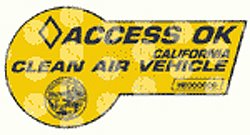
There used to be something called "limousine liberals." Now we have "prius progressives." After toasting their willingness to do something for the environment with an organic wine purchased at Whole Foods, last year they successfully lobbied the California legislature to create a special decal that allows hybrid vehicles to drive in HOV (high occupancy vehicle) lanes.
The equivalent of the smily face button during the 70s--a time of U.S. sponsored war crimes, recession and presidential travesty--the hybrid decal points to how car drivers live in a fairyland disconnected from the excrement they produce. It's as if the only natural resource consumed by cars is a highly refined bundle of biological waste, the collection of which often devastates an ecosystem. Cars also consume metals, rubber, glass and plastic made from raw materials that are abstracted in ways that bring wealth to global elites and destroy the lives of native populations. The example of the "World's Biggest Mine" operated by Freeport in West Papau shows how hard it is to scrub the blood from our modern technology.
"Prius progressives" heap scorn on smog spewing junkers, but they are responsible for perpetuating auto-normativity, while driving something that costs only a little less than a Lexus. The Prius is actually engineered to get better mileage in city driving than on the highway, and for half the price you can buy a Toyota Yaris, which gets over 40 mpg on the highway. If I had the money this is what I would buy. And when I first step in to breathe deeply that "new car smell", I would get high from the slight scent of dead flesh emanating from the dashboard. . . remembering that modernity is nothing but cannibalism by another name.
Wednesday, June 07, 2006
A trip to Norwalk III
After doing my research, I decide to take the 62 bus rather than transfering twice to get back downtown. It may take slightly longer than the trains, but this allows me to get more reading done, and I always like taking new routes. The 62 runs through the former industrial boomtowns of Downey and Commerce. In response to deindustrialization, both cities have converted former factory sites into shopping malls. In Downey a Boeing plant became Downey Landing, and in Commerce a tire factory became Citadel Outlets.
At times we travel next to I-5 and actually pass some of the cars caught in traffic. The route follows Telegraph Ave, which is a fast road. I'm feeling rather happy about my choice until the bus engine stops. Immediately I think, "another breakdown." And I can't even see the downtown skyline through the smog, so this would be a long walk. But the bus starts up, and we begin moving again, although as the bus takes off I notice a loud groaning I hadn't heard before.
I am soon back absorbed in my book until somewhere around Alameda and 6th the bus stops again, and this time everybody starts getting off the bus. I get off as well, and start asking fellow riders what happened. They look at me blankly. Nobody seems to care, it's just the routine breakdown. One man tells me angrily "Ask the bus driver!" Asking a bus rider why the bus broke down is like asking a teenager why he has pimples: it just adds to his humiliation about something he can do nothing about.

I begin to walk, at least now I am only a mile or so from downtown, but a man calls me. "Hey you! Another bus is coming!" I run back. Actually there are two buses, and I am just in time for the second, which has plenty of space since most of the abandoned already are on the first. Another assist from a random rider saves the day.
Subscribe to:
Posts (Atom)


