Tuesday, January 23, 2007

Upside down hometown

Happy new year!
Where have you been the last month?
My dear friends--those who may be reading from across the globe.
Well, I thought I deserved a bit of a vacation.

Anyway, let me begin with my trip to the Twin Cities,
MSP, Minnesota for the holidays.
My mother now lives in exurbia, a place called Rosemount.
She had lived in St. Paul my whole 40 years, but she got
married, and well things change. For a few years now my dad's
been living in Mendota Heights, first ring 'burbia
and the advantage of the most beautiful river view
on the drive to downtown St. Paul.


This drive down Lilydale Road made me see the poetry
of the Minnesota landscape with fresh eyes.
I was struck again as I crossed the Minnesota River south
of the cities.


I always considered the landscape of
Minnesota to be boring, especially in comparison
to the drama of mountains and ocean on the West Coast.
But if anything could change my mind about this beauty,
it was a fanstastic exhibit of photographs by Jim Brandenburg at the
Bell Museum, not of the forested landscape bordering
the rivers, but the prairie lands to the south that extend southwest to Oklahoma.

Driving around the cities (as we natives like to call them),
I was also struck by how narrow many of the streets and highways
were. Of course, everyone complains about the traffic, and there
were a few rush hour jams, but I could still get from Rosemount
to downtown Minneapolis in under 45 minutes during rush hour.

What is shocking about Minnexurbia is how beauty and ugliness are
so closely intertwined. One minute you will be driving down a
a road adjacent nothing but forest and grassland, until you
turn into a two year old development of pseudo neo-traditionalism--
front porches and the garage in front? A lame effort at melding
ideas of Duany Plater-Zyberk and satisfying the retiree market.

Even worse, down the road in "the big city"
(what is this Eagan or Apple Valley?) you have
a series of big box stores with chain restaurant islands dabbed here
and there amid the parking lot oceans. The roads here are
8 lanes wide with appropriate left hand turn signals at major
intersections--pedestrian traffic might as well be a crime.

My stepfather ran into a deer with his minivan the other
night. Mom said the animal was able to crawl to the other side
of the road, but the sheriff later had to go back and shoot it.
My dad just purchased some property north of the
cities so he could have some shooting land. He grew up on a farm,
but he hadn't been hunting since his college days in
Iowa City over forty years ago. What's going on here?

My Minnesota has turned upside down.
The snow on the ground was almost completely melted during the
40 degree average temps we had over the course of the week I was
there. Until the day my plane left and the storm came...

Wednesday, December 20, 2006

Wheel in the Sky


Sometimes it's hard to predict what will trigger the high pitched squeal of a pig about to have its neck sliced open coming from the throat of a six year old girl. Of course its always an accumulation: a long day in the car without a proper nap, a tummy ache from too much pop and cookies, can't find Barbie's purple princess dress... but the breakdown came when once again her pesky 3 year old sister and brother showed wills of their own.

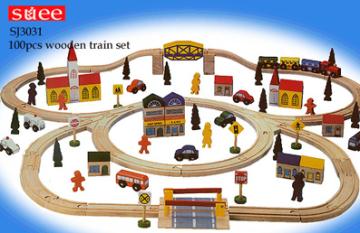
The perfect gift, I thought. The well-meaning uncle always wants to give something good for them. A wooden train would be something I could give all three. It would encourage cooperative creativity, requiring them to share and kill the "that's my toy" demon.

At first they are all very excited, but then the building begins. The great thing about this set is its ease of assembly. The track pieces can be fit together in any direction, up or down. This means it can be shaped in many ways, so the twins begin snapping pieces together randomly and setting out the little buildings and railroad workers.
"Stop!"
"What's wrong?"
"We have to make it like on the box!"
"But look, it works this way too." I push the little train along the parts of track already assembled.
"Nooo! I want to make it like the box!"

And there it is. The avalanche begins. She starts kicking apart the little scene the twins had assembled. The rhythm of the three high pitched cries remind me of the legendary 1980s punk band Flipper. "Sex Bomb Baby Yeah!"

Our mayor is a bit like the well meaning uncle, believing he has the perfect gift in the form of a Wilshire Ave subway to the sea. He is even more like my niece, dreaming of how perfect the train looks like on the box, not wanting to start building anything else that might work--like bus only lanes--because it doesn't match his rail set in the sky.

Meanwhile us riders on the ground wallow in dawdling. Like the other evening, it took me nearly 45 minutes to go 2 miles south from Hollywood to Beverly. Dear dreamer, this isn't some obscure corner in the middle of the Valley. This is Hollywood and Highland--the closest L.A. has to a Times Square!

Once again only Journey will suffice:
Ive been trying to make it home
Got to make it before too long
I cant take this very much longer
Im stranded in the sleet and rain
Dont think Im ever gonna make it home again
The mornin sun is risin
Its kissing the day

Wheel in the sky keeps on turnin
I dont know where Ill be tomorrow
Wheel in the sky keeps on turnin

And that is my Holiday Gift to you--The Mad Bus Rider will be on Vacation for the next two weeks.
Happy New Year!

Monday, December 11, 2006

Paradise Now

Easily the most popular destination in the Valley and one of the most popular in all of L.A. is Universal City. From my first trip to California in '76 I still remember the mechanical shark attacking our tram and thinking, even as an eleven-year-old, how fake Jaws looked up close. More frightening was the hyper-real avalanche of five foot high stones that "accidentally" fell when an earthquake struck--the hills really shook!--until they bounced silently on the road and I realized they were foam.

That night I'm not sure where Dad parked the '67 Winnebago trailer and golden brown Dodge Van we packed with ten kids, but a five mile venture to the northeast on the Hollywood freeway would have encountered what made the Valley a Shangri La for the workaday Joe not part of the entertainment world.

In the 1970s Panorama City was still the booming Levittown of the West, with the San Gabriel Mountains as majestic backdrop, set on curving streets, glorious 3 bedroom tract homes, astro turf perfect front lawns, and American built cars in every driveway--perhaps even my Presbyterian Minister Grandfather's standard: the Impala, built just down the street at the GM plant adjacent the Southern Pacific tracks that border Van Nuys to the south.The plant closed in 1992 and six years later a shopping mall emerged on its site calling itself "The Plant". One supposes the name is meant to evoke images of old time industry much like Cannery Row in Monterey or Ghirardelli Square in San Francisco remade former warehouses and factories into popular tourist shopping districts. But whereas one could call these places classic simulations-- reconstructing the past minus its drudgery, pain and class conflict--"The Plant" reconstructs nothing but another hideous big-box mall.Based on appearance, "The Plant" might refer to the Palm Tree that sprouts up randomly amid a sea of parking spaces. Yet across the street is the anti-simulation: an abandoned ten acre facility reminds visitors of the 5000 lost jobs and the general deindustrialization that cracked and crumbled the backyard pooled paradise no less than the Northridge quake of 1994.On the always overcrowded 233, passage underneath the tracks marks ones arrival into this old "New City", and on arrival back to grade level, above a row of bulldozers, opposite "the Plant", a billboard proclaims "hundreds of great places to hang out in L.A.", as if asking "so what the hell are you doing here?"

Monday, December 04, 2006

Attachment

A woman in her 60s is looking at a brochure on face injections. Before and after photographs reveal wrinkles and less wrinkles around closed mouths. From her purse, she removes a tiny booklet with smiling sun on the cover and glances at the Bible verses inside.

In the 1930s the De Beers diamond cartel with the marketing brilliance of N.W. Ayer transformed an abundant colorless stone into a mandatory overpriced engagement ecstasy for young Americans. In the 1960s De Beers hired J. Walter Thompson to internationalize the delirium. Greatest success came in Japan where attaching diamonds to 'modern western values' meant every 'progressive' Japanese couple now dreamed of yen-laden sparkles.

Throughout most of the twentieth century few consumers knew the savage conditions under which mostly African diamond miners slaved. However, in the 1990s the role of diamonds in funding wars in Angola, Sierra Leone, Democratic Republic of Congo and Liberia led to campaigns demanding a stop to the cartel's complicity. Despite an agreement reached in 2003 to end bloodshed by the rock, human rights groups say promises have gone unfulfilled.

Regardless, as shown in a searing photo essay from Foreign Policy Magazine, miners continue to work in harsh environments and suffer destitution in fulfilling the romantic fantasy of a waitress at TGIF's in Simi Valley, whose boyfriend, a bartender there, just charged 3 and 1/2 grand on his Capital One MasterCard that he'll attempt to pay back at 13.9% over the next five years.

Diamonds are hardly the only attachment that funds violence and cruelty. The mining of coltan, which reached peak prices from 2000 to 2002, assisted the diamond in funding the Congo wars, where over 3 million died. More recently, despite the peace agreement of 2003, cassiterite has been extracted under threat of mutilation and torture by resource starved rebel armies in the northeast.

From coltan is processed tantalum, a powder essential to the manufacture of featherweight capacitors found in most cellphones. Likewise cassiterite, which is seen as an environmentally friendly alternative to lead, is used to solder the elaborate micro electronic components that bring wireless connectivity to life.

The woman looks over at me. "Cellphone?"
I look at her quizzically.
"Cellphone?" She asks again.
I shake my head.
My emptiness chills me. Then I think, "What if it rings?"

As we pass the Catholic Church at White Oak and Ventura the two young men on the back seat cross themselves. The woman sees them and smiles.

Sunday, November 26, 2006

Street Vermin

Clunk!
What the hell was that?
Where are we?
Somewhere around Cedar Lake or is it Lake of the Isles?
The twisting streets roll from one to the other and the multistory Georgian revival and craftsman homes blur together. We are lost.
It is a late fall Saturday night in 1982, and we are drunken teenagers looking for a party.
Was it from frustration or thrill that Ryan was driving too fast?
The street curved left, his parents Honda didn't quite. We hit the curb.

We get out of the car.
"Shit!" Sam's laughing. "Check that out!"
The hub cap is crumpled and the wheel seems crooked.
Ryan thinks quickly.
"Let's find another Honda. We'll just switch the hubcaps."
Sam laughs. "Yeah, let's fuckin' do it!"
We find another Honda, and Ryan pops it off with a crowbar.
Somehow they wrestle it on to the broken wheel.
We take off.
SssskkkkaaSssskkkkaaSssskkkkaa...
It didn't do anything.
That car was wrecked...a broken axle.

Mothers Against Drunk Driving achieved their greatest lobbying success in 1984 when the National Minimum Drinking Age Act forced every state to change their drinking age to 21, but is it the liquor that kills or the car?

We have a cultural design problem. Alcohol is a central part of U.S. culture, and our cities do not permit us to go out drinking without also driving. Why don't groups that spend millions promoting "the designated driver" advocate better public transportation and urban design with the same fervor?

Drunk or sober at 16 we were all speed demons. We took any chance we had to make our tires screech. The likelihood of a teen driver bending metal must be near 100%. While local news obsesses about the dangers of ghetto youth, the violent urges of suburban kids are allowed to wreak havoc on the highways.

T.W. Adorno writes,"Which driver is not tempted, merely by the power of his engine, to wipe out the vermin of the street, pedestrians, children and cyclists."

In other words, the callousness of the NRA's dogma "Gun's don't kill people, people kill people," is equally sick if applied to automobiles.

George Weller may have hit the gas, but his 1992 Buick Le Sabre killed 10 people.

Monday, November 20, 2006

Thanksgiving 2006

For the Sunday before Thanksgiving I was asked by my pastor to speak briefly to our congregation on what I was thankful for. This is what I said:

Thank you Miss Rosa, you are the spark,
You started our freedom movement
Thank you Sister Rosa Parks.

These lyrics by the Neville brothers honor the famous seamstress from Montgomery Alabama who defied the violence of Jim Crow and inspired a struggle for civil rights that continues to this day.

I hear the soaring vocals of Mahalia Jackson wash over me whenever I consider the courage of heroes like Parks, Dr. King, James Lawson, John Lewis, Fannie Lou Hamer...

And I am equally moved when I think of the thousands who often go unnoticed in their work for social justice.

One of these is Hee Pok "Grandma" Kim who learned her activism as a child aiding the Korean resistance to Japanese occupation and now in her 80s organizes fellow immigrants to demand the transit bureaucracy improve the deplorable conditions faced by the mostly working class people of color who ride the bus in L.A.

When I hear Christians say a million dollar home in the Encino hills with a collection of Porsches in the garage is a sign of God's blessing I am somewhat confused. It is true that everything we have is a gift from God, but shouldn't we see the truly blessed as those who have the strength to abandon material possessions--like the followers of Jesus--and give their lives over to serving the poor, the weak, the oppressed?

I don't have the gifts of a Parks or a Kim, but their resolve, and those who share their thread of the divine keep the dream flashing, pushing the divine within me to change the world.
And this is what I am thankful for.

Monday, November 13, 2006

Loft Living

Skip a life completely.

I have reached my seat and the bus door is closed.
"She's Coming!"
A woman with a cane is persistently limping down the sidewalk.
The bus pulls away.
"SHE'S COMING!!" the man shouts again.
The bus stops, and the woman steps on.
"I know we're in a hurry," the man comments.
"Safety is the MTA's number one concern." He looks back at the woman sitting behind him and shakes her hand. "Am I right?"
At the next stop several people get on.
"Step on up and find your seat. We're in a hurry," he says.

Stuff it in a cup.

I've seen this guy before. The commentator. He calls all the stops with the flourish of a streetcar conductor of old. "Victory Boulevard, transfer here for line 164."
When the bus is crowded he calls, "Let'em on, Let'em on! Move to the back!"
As people move off-"Watch your step. Don't forget your belongings."

She said, Money is like us in time,

In between messages, he engages in conversations with his neighbors. They must be one way conversations, but he is such a great performer--leaning in close, eyes engaged--it looks like talk between intimate friends.

It lies, but can't stand up.

These bizarre Augenblicken of public closeness remind me of a stoned moment from the summer of '88 sitting on the roof of a loft in downtown Minneapolis. At the top of our voices we sang Lou Reed lyrics to yuppies walking in and out of a Sports Bar.

Down for you is up.

Competing to see who could hold the longest note, that night I had the lungs of an elephant.

Linger AAAAHHHHAAAAAAAAAAAHHHHHHH....ooooon!!!!!

The response from below was mixed. Most smiled and waved, but one guy, in an apparent effort to defend his ladyfriend from the serenade of strangers, looked up and shouted, "Shut the fuck up you Faggots!"
In our euphoria, we took this as encouragement. After all this was Minneapolis, where the night before we had visited the Disneyland of Gay Bars, "The 90s", which, on floor one, had both a male strip club and a disco, floor two, a piano bar, and floor three, a drag show.
"We love you too, Cutie!"

your pale blue eyes.

Sunday, November 05, 2006

Begin the Diversions

Heading south on Reseda at 2:15 on a weekday afternoon it is not unusual to hit a clog, but today is different. It's like we're waiting in line for American Idol try outs. What's the delay? Twenty minutes and four blocks later we find out. They are resurfacing a stretch of Reseda between Roscoe and Saticoy, so the two lanes of southbound traffic have to be diverted onto one of the northbound lanes. The Roscoe stop is on the south corner, but the driver lets people off on the north before merging to the left. On the south corner, a half dozen people wait, unsure what to do since the street in front of them has been torn up and blocked off from traffic. In other words, the bus can no longer pull up to the curb, so where will it stop? As the light turns green and the bus finally heads south into the northbound lane they find out--the bus just drives on by as they wave their hands hopelessly in the air.

Not surprisingly, at any given time there are over a dozen major resurfacing projects taking place on the streets of Los Angeles. The Bureau of Street Services has an annual budget over 170 million. Most of this budget comes out of general revenues collected on all city residents, whether they own cars or not. This makes sense since streets are vital to urban infrastructure. Only the most hard core libertarian would argue local streets be privately funded--each person choosing whether to surface in front of their house or not, making driving to the grocery store a bumpy adventure constantly moving from asphalt to gravel to dirt to cobblestone.

In Europe, mass transit was early on recognized as an equally important part of the transportation network that required publicly funding. By contrast, in the U.S. it was considered a private business which not only should be self-sustaining but also taxed, helping to fund the construction of roads. This logic, not--once again it must be emphasized--a GM conspiracy, is largely responsible for the collapse of public transportation in U.S. cities, including L.A.

This does not mean the auto lobby was without influence on public policy. One of their biggest victories was convincing both states and the federal government to create highway trust funds. These funds created out of gas taxes and other auto related fees were dedicated solely to the construction of highways helping to create the fantastic "freeway" systems that dominate cities. States created constitutional amendments prohibiting the diversion of these funds to anything but highways. This sounds reasonable until you realize that cars have to eventually leave the highway and go on local streets, paid for by local municipalities. In the 1970s cities recognized the need for public transportation, and a small slice of highway funds began being diverted to mass transit, but by then the damage had been done.

Non-divertability is still a bad idea, so I am opposing proposition 1A, which extends the restrictions on California's highway fund. Yes, it is now called the "transportation fund", and a sliver goes to mass transit, but the problem with non-divertability is it gives the illusion that car drivers are paying their way. As has been pointed out, gas taxes would have to be at least twice as high to cover not just the cost of local streets but also police and emergency services that keep drivers from killing one another any more than they already do.

On the other hand, to redress the legacy of transit neglect, non-divertability might be a good idea. No money should be diverted to building highway lanes until all California cities have fast and convenient public transportation.

Madaboutla's proposition recommendations:
State:
1a no
1b no---more highway lanes/more smog.
1c yes--I'm not a big supporter of state bond measures, a way to redistribute wealth to Wall Street elites, but housing is in more of a crisis than transportation.
1d no--of course we need money for education facilities, but progressive taxation, not bonds is the answer.
1e no--isn't flood control precisely the cause of ecological disaster?
83 no--even victims rights groups oppose this malicious measure.
84 yes--more bonds, but this flood control measure has a conservation focus.
85 no--sure children should let their parents know if they're in trouble, unless their parents are the trouble.
86 yes--higher cigarette prices, fewer deaths.
87 yes--higher gas prices, fewer deaths.
88 no--a new kind of regressive tax.
89 yes--public campaign financing is a start.
90 no--"property rights"=land theft.
City:
H yes--affordable housing bonds.
J yes--what the heck?
R yes--term limits are bad but lobbying limits are good.

Friday, October 27, 2006

Smashing Pumpkins


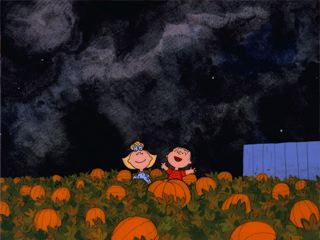
(Image from www.snoopy.com)

You may wonder where in the world my blog was last week. Well I was visiting the fascinating city of Arlington, Texas where my Great Aunt was celebrating her 90th birthday. Arlington's fame comes from it being home to the original Six Flags theme park, the Texas Rangers' Ameriquest Field, and the future stadium for "God's Team" the Dallas Cowboys. It's also the largest city in the U.S.--360,000--without a public transportation system.

Congressman Joe Barton, whose district includes Arlington, you may remember is the Energy and Commerce Committee Chair that played the role of organ grinder monkey leashed to his oil company owners at the "hockey stick" hearing in July. He's also responsible for 2005's Gasoline for America's Security Act that doled out money by the billions to his patrons in the petrobiz.

All these subsidies make the claim by Marketplace commentator David Frum that the free market will efficiently supply our energy needs similar to claiming the Great Pumpkin will deliver toys to all the good boys and girls waiting in the pumpkin patch--you might as well try trick or treating in Bel Air.

Joe Barton--whose middle name is Linus!--is clearly a blockhead with a B.S. in Industrial Engineering and M.S. in Industrial Administration who seems to think spreading toxic waste is like giving out candy on Halloween. Still those who attribute car dependency to corporate conspiracy live in the same comic book universe as those who believe the CIA was behind 9/11. In several hilarious columns Alexander Cockburn takes on these loonies who pester him with details "proving" that the government planned the whole pyrotechnic slaughter.

What's dangerous about conspiracy theories is not that they are always wrong--after all, Hoover and his cronies at the FBI did conspire to undermine civil rights by infiltrating groups like the Black Panthers with agents that provoked violence and disillusion in the movement. The problem is that focusing on the Machiavellian power of a few hides the complicity of the majority in maintaining the status quo. If it was simply a matter of exposing the manipulations of corrupt "Princes", then politics would not require the difficult work of organizing diverse coalitions through democratic dialogue.

The sad fact is that the lack of public transit in Arlington has little to do with the power of Chevron or GM, whose plant in Arlington assembles Chevy Tahoes and Cadillac Escalades. Instead the mostly white middle class residents three times rejected proposals to bring buses to their streets because they did not want their neighborhoods full of poor people. It's just like when you were seven and thought goblins were responsible for egging your house and smashing your pumpkins that late October night. Later you found out it was the high school kid down the block named Billy.

Saturday, October 14, 2006

Master and Commander

The manufacture of automobile tires is a complex process. Natural rubber is still frequently used, harvested mostly in Southeast Asia, but synthetic rubber is also common, constructed from a variety of petrochemicals such as polybutadiene and isobutylene. Actually, tires often combine multiple chemicals to find the right balance of elasticity and strength. In addition to the rubbers, their curing process requires a complex mix of carbon, silica, sulphur, and other chemicals that only a team of research scientists could perfect.

So where do these chemicals come from? Increasingly they come from China, where, for example Eliokem now produces Wingstay L phenolic antioxidant in Ningbo, China. Meanwhile Bridgestone has built four tire plants directly in China--Tianjin, Wuxi, Huizhou and Shenyang--might as well be close to the source.

This is all quite interesting because according to Germany's Der Spiegel, China is now "the world's toxic waste dump." On November 13 of last year a petro-chemical plant exploded in the city of Jilin, killing five and forcing water to be cut off to the 4.6 million people living in the city of Harbin. Der Spiegel writes, "According to official statistics, 350 Chinese die each day in industrial accidents, but the unofficial figure is likely to be much higher."

More recently, the Los Angeles Times did a story on Huashui, China where thousands of villagers battled police in April of last year while protesting the devastation of their farm land by local chemical factories. Many protesters remain in jail, but the factories were removed--at least for the time being.

This all came to mind the other day when a woman yapping on her cell phone nearly rolled me over in her Lincoln Navigator while I tried to cross Ventura Blvd--and yes I did have the green. On the Navigator website one sees the 50,000$ monstrosity in the middle of a desert completely paved with cement blocks, with cirrus cloud streaked sky above and mountains in the distance. Perhaps this endless driveway is what the commander of this boat dreams of inside tinted glass, surrounded by "premium leather and American walnut burl wood" trim, listening to soft rock on the "Soundmark® THX™ Certified Audio/Navigation System", comforted by a "Dual-zone Electronic Automatic Temperature Control (EATC)", consuming gas at 13 mpg.

Just like that other Navigator, whose venture of mass murder and pillage was honored with a federal holiday last week, dreamed that nothing but empty sea separated him from the wealth of East Asia. His calculations were a little off, but over 500 years later, progress has finally reached there anyway. The economic miracle now flows through China, like the dead fish flowing down the Songhua river. (image from bbc.co.uk)

Saturday, October 07, 2006

Outhousestanding

Currently advertisements throughout L.A. proclaim "Metro has been named Outstanding Transportation System by the APTA. It's nothing less than L.A. deserves."

This is much like mom saying in the 1950s her uncle had the finest outhouse in rural Tennessee when everyone she knew in her Illinois town had flush toilets by then. "Metro" may be outstanding, but it is still merely a string of wood planks with a whole cut into it with a stinking mess of feces and urine in a pit below.

Saying a public transportation system is "Outstanding" in the U.S. is like saying that eight year old boy I saw doing some traditional Polish dance last Sunday in Verdugo Park was "Outstanding." Sure, the serious look on his face while he awkwardly bumped into his dancing partner was very cute. But since they are merely a group of eight year old kids who practiced for an hour six Saturday's in a row--except for Suzie who was sick one day and Kevin who was crying uncontrollably that one morning because daddy put cinnamon and sugar on his toast, and even though he wanted it on, HE wanted to put it on himself--one is impressed they even remember to twirl when they are supposed to twirl. But it's really nothing like going to see the professionals of Podhale.

The public transportation systems of European cities are flush toilets next to the piss poor service we have in the U.S. New York is somewhat of an exception--there are plenty of places where the subway smells like piss, but at least you can get from the Bronx to Coney Island in under an hour. By contrast, when I went to see those kids perform at the Unity Festival, it took me over two hours to get from Encino to Glendale, approximately the same distance.

And last Friday, in mid afternoon, at the corner of Wilshire and Vermont, I waited 15 minutes before squeezing onto an overloaded "Rapid" bus, which then took twenty minutes to arrive at USC, a distance of exactly 2.5 miles. Metro celebrates the Rapid Bus as a prime reason they received the APTA award, but for actual bus riders, the "Rapid" is a sad joke. As I have discussed, it is often just as slow as the regular bus because it has to manage the same traffic jams as every other vehicle that crawls up and down Vermont or Wilshire or Ventura. And as I have also mentioned before, the solution would be cheap and fast: bus-only lanes on these thoroughfares.

Instead our Mayor and the propogandists behind this ad campaign--who don't actually ride the bus but love looking at statistics saying the Rapid is 25% faster than the regular bus--sure and this is 25% slower than that fourteen year old girl on her one speed beach cruiser--are calling for billions to be spent on extending the rail network. Let's say in twenty years our Mayor's dream is realized, and two rail lines to Santa Monica are completed, it would still take me 20 bleeping minutes to go 2.5 miles south on Vermont!

Mayors love to fantasize about future monuments to their reign, in the meantime people who live in the present get stuck in a barn with manure a half-foot deep. That's why the Bus Riders Union needs people who know a crap hole when they see it to show up October 17 and demand a halt to all rail projects until a true rapid bus system is built. And while we are at it we should demand future board meetings be held outside with a port-o-potty standing behind each of the board of directors seats. Its nothing less than L.A. deserves.

Monday, October 02, 2006

Teenage Troubles

In high school I was a skinny awkward misfit who sat at the lunch table with the other oddballs with no social life. Perhaps this is why I am uneasy with the rush of high school kids who pack the bus around 2:30 in the afternoon. Suddenly I'm transported back 25 years and kids are slugging me in the stomach until I pass out and wake up staring at the nurses office ceiling, becoming the school's source of laughter for the next month. Harris and Klebold were hardly the first to fantasize about wasting those who ostracized them. Fortunately, punk rock was more my style than semi-automatic weapons.

Riding the Ventura Rapid line back from Target we stop at Winnetka Ave with over fifty Taft High students squirming to get on. At the back door waiting to get off are a teenage girl wearing Sony closed headphones in black jeans and t-shirt and a younger boy talking into his cell phone. The back door does not open, but they just stand their as the Taft students push their way onto the bus. I suppose they recognize the busdriver is busy managing the crowd and has forgotten to open the back door to let them out. After a minute or so, the two of them start looking anxiously towards the front of the bus. Finally, the boy says somewhat weakly "back door," but the door doesn't open.

All the students are now on and the driver shuts the front door. The bus is packed with chattering high schoolers, many with their cell phones in one ear, seamlessly integrating conversations through real and wireless space. The bus begins to pull away. "Back door!" The boy has apparently lost his patience. The bus stops for a moment, but only until the light turns green, when it starts off again. The girl begins knocking on the door's window. Once again, the bus stops--but the driver's just waiting for a car to pass so he can merge into the center lane. We fly on. The boy waves his hands hopelessly, "what the...?" The girl just stares silently outside the door and the rest of the bus seems oblivious. The next stop is Reseda--a long two and a half miles.

Ah, the humiliations of youth. But it will all be over soon. In a few years she'll have her Associate's in Phlebotomy and earn 30,000 a year drawing blood in a Valley lab. And he'll pull down 12 an hour re-shelving dog-eared books and magazines deposited by dawdlers at the Hollywood Border's--or at least the one in Glendale.

Monday, September 25, 2006

LA vs NYC II


I recently bought a book called Counter Intelligence: Where to Eat in the Real Los Angeles by Jonathan Gold. There are many problems with this book, but I want to focus on one: below the title it states "the indispensable eats guide to America's most diverse food city." Los Angeles is America's most diverse food city? I don't know why I should expect a book cover to be any more truthful than those idiotic milk ads, which claim cow's milk--one of the most dangerous products of industrial agriculture--is actually good for you, leading the Physicians Committee for Responsible Medicine to file a complaint with the FTC. But the claim of "the most" about any city always bothers me, and its worse when it comes to some vague category like cuisine diversity. Now if it was something like "tallest building in the U.S." or "largest indoor shopping mall", this is a little easier to measure, but what does "most diverse food city" mean?

Most likely it is based on the idea that L.A. is the most diverse city. But L.A. is hardly the only city to make this claim. Of course, the question is how do you define diversity? Based on research conducted by The Civil Rights Project of Harvard, Time Magazine declared Sacramento America's "most diverse city." Reading the article you discover by "most diverse" they mean "most integrated." Nearby Oakland also describes itself as "America's most diverse city" because "More than 125 languages and dialects are spoken." Oh, but wait a second, according to the New York State Comptroller 138 languages are spoken in the Borough of Queens alone. Another definition is found at the Skyscraper City forum, where I found a list of cities with the smallest "majority group," putting Waipo Acres, Hawaii at the top. Even my home town of St. Paul brags of having the most "balanced" diversity because, although it is majority white, it has significant numbers of African Americans, Latino/as, Asians and Native Americans.

So lets presume the publishers do not mean simply that L.A. is the most diverse city but that it just has the most diverse food. And here their argument is probably based on the size of the immigrant population. Woops, once again it depends on what you mean. If you mean the percentage of foreign born in a city's population, Miami wins easily, followed by Santa Ana and then L.A. But if you mean counties--which is what the book must mean since many of its entries are in places like East L.A. or Pasadena--then once again, after Miami, our old friend Queens is back, followed by Hudson, New Jersey, then Kings--that is Brooklyn--then San Francisco, and finally L.A. comes in at number six. If we take 2005 data and compare Los Angeles County to the city of New York it is pretty close. 36.6% of New York is foreign born, 36% of L.A. So L.A. and NYC are roughly the same--except there is a factor missing here. L.A.'s immigrant population is over 50% Latino/a, and that Latino/a population is over 80% Mexican. By contrast New York's top three immigrant groups are Dominicans, Chinese and Jamaicans and only Dominicans are more than 10% of all immigrants-about 14%.

My point is not simply to once again dismiss any challenge by L.A. to NYC's status as the center of the cultural universe--well it kind of is. But even if L.A. did have near the diversity of New York, experiencing that diversity is like trying to eat ice cream with your fingers. You can do it, but after a while the sticky mess starts driving you mad. Sure there is great Chinese in Monterey Park and Ethiopian on South Fairfax, but getting from here to there is a sticky situation. In New York, the subway is your ice cream scoop. Better yet, let your legs be your spoon. On a single stroll you move from stores and restaurants catering to Greeks, Indians and Ecuadorians. Yes, I'm sure that Uzbeki place on La Brea and Sunset is "very authentic," but who wants to drive from the West Valley at rush hour and then dump another 5 bucks on valet parking--and they say you have to be rich to live in New York. No, I think I'll just pick up a pint of Baba Ganoush at my local Persian deli, go home and watch Huell Howser eat some Macapuno at famous Fosselman's in Alhambra.

Monday, September 18, 2006

Million Dollar Tween Critic

I'm waiting for the blue line at Artesia Blvd and a kid around thirteen is hopping about the platform.

"What's up?" He says while running his hand up and down the station sign.

I try to focus on my book. In general, I'm not quite comfortable talking to strange kids. Too often they act like me when I was there age--any conversation is an opportunity to make a joke at your expense. Besides, his question seems more of a distraction for him, something to do while playing on the platform, rather than a serious attempt to engage in a conversation.

"What's up?" He says again, this time more clearly directed at me.

"Not much. What are you doing today?"

"We're going to a movie." I then notice he is with his mother who looks over and smiles at me from a bench.

"What movie are you going to see?"

"Idlewild."

"That's funny. I haven't even heard of that movie."

"Hollywood movies are crap."

"Huh?" His bluntness takes me by surprise.

"They are almost always about the problems of rich white people, and when they do present stories about the poor, its through the windshield of their Porsche Cayennes. Take 'Million Dollar Baby' for example."

"Didn't that win best picture?"

"Exactly. The industry loves movies that appear to sympathize with the poor, as long as the poor meet their bourgeois standards."

"What do you mean?" I'm a little shocked by his language.

"That film is so awful not because it's packed with clichés and extreme sentimentality but because it perpetuates a malicious division between the deserving and undeserving poor. Hillary Swank's character works hard at a low wage job and saves every penny. She embodies the Reaganite dream of how the poor can become rich if only they have the proper discipline. In contrast, her mother and sister are scheming welfare cheats who want something for nothing."

"Really?" I am becoming more impressed with this kid.

"Even though the women in this film are white, the welfare mom is a stereotype that emerged only in the 1960s when black women challenged the discrimination that prevented them from receiving the same benefits that went to whites. In other words, it is a profoundly racist stereotype that ultimately led to the vicious welfare reform law passed by a Republican Congress and signed by President Clinton, which forced mother's to find work without providing child care or health insurance. Of course the bourgeois media has celebrated the 'success' of this law in getting former welfare recipients into the workforce, meanwhile the poverty rate is static, the number of uninsured continues to increase and homelessness among families is at crisis levels--probably because the mothers couldn't find work and faced the reality of 'Temporary Assistance.'"

"Wow!"

"Not surprisingly, this film shows a complete ignorance of welfare policy and depicts the women actually turning down a free house because they might lose government benefits. When I saw that scene I didn't know whether to laugh or scream 'What is this, Vanilla Sky II?' Oh and by the way, did you notice how they suggested the female champion, who was black, always won by cheating? That film was flat out racist."

"Kenny." His mother begins to walk over. "Stop bothering that man."

"Oh, he's not bothering me." Kenny goes back to running around the platform. "Beautiful day."

"Sure is." She waves her arm in a fan like motion. "It's finally started to cool off a bit."

"Yep. Finally."

"Oh here's our train. Have a nice day."

"You too." I see her rush over to take Kenny's hand. He gives me a smile and waves goodbye as they step through the sliding doors.

Monday, September 11, 2006

Sugar-Free Marketeers


Splenda/Sucralose

The fantasy of the free marketeers is the fantasy of Splenda. The popular artificial sweetener, said to be 600 times sweeter than table sugar, is made from mixing chlorine with raffinose, a sugar derived from various vegetables. As with saccharine and aspartame, it is often combined with other potions/poisons, in an attempt to cover a soapy aftertaste--sweeteners such as acesulfame-k, salts like sodium ferulate. They never quite work but over time that aftertaste seems natural, and people begin to crave it.

A recent study by the Reason Foundation, a libertarian think-tank, found "Traffic delays will increase 65 percent and the number of congested lane-miles on urban roads will rise by 50 percent over the next 25 years." Fortunately, they say, the solution is cheap. Simply spend $533 billion to widen highways and don't waste any more money on public transit. The author of the study, David T. Hartgen, a Professional Engineer and Professor of Transportation Studies at UNC Charlotte, has done extensive research to show that widening highways is more effective than public transit projects in reducing traffic congestion. Why? Because people love cars and don't use public transit. Of course, he means white middle class people, but still his "reasoning" has a certain space cadet logic. Just like food engineers might achieve the right balance of sweetness by adding a few milligrams here or there of this or that powder, transportation engineers will be able to create a smooth flow of traffic by just adding a few lanes of traffic here and there--and the chemical aftertaste of neocolonialism and dead fish will dissappear.

Iraq is hardly the only place where blood is shed to keep our cars running. In the Niger Delta, 1000 people are killed each year, violence that western oil companies accept as part of doing business in the region, and while the region brings enormous wealth to these companies, most people who live there are destitute.

Meanwhile, a United Nations study found there are now over 150 ocean dead zones, where the lack of oxygen prohibits the survival of fish and other creatures. These zones are created by global warming and land based run off, including tailpipe pollutants, which is why author David Helvarg lists reducing automobile trips as one of the top 50 Ways to Save the Oceans.

Perhaps one should not expect a transportation engineer to care about geopolitics or ocean health, but one should expect an interest in numbers, and there have been numerous studies showing the cost of supporting cars is much higher than the expense of building roads, which are only partially covered by gas tax revenues.

Let's just take the highway patrol for example. The 2006-2007 budget for the California Highway Patrol is over 1.5 billion. Imagine how much more it will be if we simply continue to "accommodate" the growth of automobile usage. But maybe these anti-government activists would prefer we stop funding this bloated institution that restricts our freedom to race the roads, and we could just let the blood spill until highways are covered with a faint pink film, much like the color of my Splenda flavored cherry popsicles.

Monday, September 04, 2006

The City of Sin

When you take the bus, you also walk. And walking you actually might meet someone you know. You also meet the homeless, although in So Cal they are usually panhandling at freeway exits with cardboard signs saying "homeless veteran, please help". Even panhandling here has drive-thru. Still, it is often pedestrians, the fellow poor, that are most generous. They know it could be them on the street, and they can stop and visit after dropping a dollar in the cup.

Another hundred degree day in the valley, and I just missed the bus, arriving at the other side of the street, a guy I know to be one of the sidewalk donors, is about to cross.
"Hey Ed, what's up?"
"Hey man, what's goin' on?"
"Nothing, where you headed?"
"Just getting something from the store. Hey, you know we're moving to Vegas?"
"Really? You find a job there?"
"Nah, Its just too expensive here, and Meena can't find any work."

According to a Center for Housing Policy study measuring the median wage against the median cost of rent, Los Angeles continues to be one of the least affordable cities to live in. This is not likely to change much despite recent passage of a bill that would raise California's minimum wage to 8 dollars an hour by January 2008.

Let's say you can find a Van Nuys Studio for 800 with bad AC and roach scat in the cupboards. After deductions you bring home maybe 1200 a month. That leaves you with 400. Even for a healthy guy like you, that's about the cost of health insurance, so if, while running to catch the 573 commuter express taking you to the coffee shop in Westwood, where you work but can't afford to live, you slice your ankle on a rusty muffler clamp shot from the street by the tire of a jock rocket ripping by at 65, but you avoid the doctor until the pain of walking on your purplish puss filled limb is too much, and you go to the hospital, where you are billed 700 dollars for treatment plus meds, well then, welcome to Vegas.

"So you got family there?"
"Yeah, I gotta brother and Meena's daughter lives there."
"Aw, that's great. Hey, and you'll have weather like this all the time!"
"Yeah..." He looks off at the intersection blankly.
"I'm just joking ya man!" I swipe at his shoulder with a fist.
He smiles and gives me a quick shake.
Just then an old Chevrolet sputters to the stop in the middle of the intersection. Ed runs to help.
After it won't budge he yells, "You gotta put it in neutral!"
Me and another guy run out to help push the sun faded beater to the curb. The seven man pit crew jumps over the wall and goes into action. They change tires, fill it with gas and push Jimmie Johnson back onto the track, and he goes on to win the UAW-DaimlerChrysler 400.

Monday, August 28, 2006

Torn and Frayed

"What school?" The man at the bus stop is talking to me. Apparently he overheard my cell phone discussion of fall semester's return.
"CSUN."
"Northridge, heh. You know the stadium there, close to Devonshire and Zelzah? We carved our names into this big oak tree back in '76, but they cut it down."
"Oh."
"Yeah. I ran cross country for Granada Hills High School under Coach Godfrey. He was tough, man. He really worked you, but he was good. They won 16 city championships."
"Oh Wow! So did you go to the state championship?"
"Some guys went, but you know that costs money. I didn't have the dough to go." He rubs his fingers together indicating "no bills."
"Ah, I see."

Looking at him now, despite his age and the fact that he is dragging the last puffs from a cigarette butt, you could see the long distance runner in him. In fact, he likely covered the same distance today, only now he did it with an overstuffed canvas backpack and bedroll tied atop, causing him to lean slightly forward. This meant he could not reach the speed of his youth, but he was in a different category of competition these days.

A layer of grime, commonly found on outdoor furniture in the city of smog, covered him from his long graying hair to his frayed sneakers. A long bushy beard reminded me of John Muir. Here he was trekking through San Fernando Valley, just as Muir had trekked through Yosemite, telling the world of its beauty. His skin, where exposed, was wrinkled and red from the sun. Living on the street had made him deeply attuned to L.A. design trends: his jeans had wide torn holes to expose his lobster like kneecaps.

Back in the 1950s, when young people began wearing blue jeans, it was to show solidarity with the struggling worker, so one wonders if the current fashion of wearing ripped jeans shows solidarity with the struggling street person. Maybe if these kids met this friendly conservationist of the twenty first century, he would inspire them by his creative fight for urban sustainability. The tear that rips across the denim thigh could signal the desire to tear apart the concrete that now kills the Los Angeles River. Reviving this waterway, a long battle engaged in by Friends of the Los Angeles River, would be a small but vital part of returning wilderness to San Fernando Valley. Another would be to have Jennifer Anniston, born in Sherman Oaks, return to the valley, and take her Chip and Peppers for a walk.

Monday, August 21, 2006

corn pops


One day when dad was a farmboy in southeastern Iowa, he noticed a big owl was falling silently into the chicken pen, piercing its claws into the necks of White Leghorns and Rhode Island Reds and snatching them for lunch. So he takes a chicken carcass and sets up a simple cage trap. When the owl went to grab the flesh, the cage would fall on it. As planned, the next day dad finds the big bird knocking its wings hopelessly inside the cage wires. Carefully, dad lifts up the cage and knocks the bird on its head with a big rock. Proud as a boy coming home with straight A's on his report card, he runs to tell grandma.

"Ma! I caught that owl that was stealin' our chickens. Come and see!"

"What? No. I don't want to see that."

Undeterred, dad decides to bring the dead owl to the door for grandma to see. But when he returns to where he left it, the cage is missing. That was one strong owl. Apparently it had only been knocked unconscious and had crawled off with the cage. Fortunately, it couldn't crawl far, so dad finds it and this time knocks the big head really hard 'til that owl is good and dead. He ties a rope around its neck and drags it to the door to show grandma.

"Ma! Look, I have the owl right outside the door!"

Grandma, a small but tough woman, daughter of Swedish immigrants, is scornful.

"What'd you do that for? Huh? What'd you go and kill that owl for?"

"But," dad says defensively, "it was killin' our chickens!"

There aren't too many wild birds left in Iowa, which is now the most industrialized state in the nation. This artificial landscape, revealed by Michael Pollan in his book The Omnivore's Dilemma, emerged from the systematic destruction of biodiversity and the creation of processed food's Hiroshima: corn fields.

The environmental disaster called Iowa came to mind when I recently learned of the new trend among Silver Lake hipsters to have classic Mercedes converted to run on biofuel. The enthusiasm for biofuel cars emerges from the same junior high school reasoning responsible for the electric and hybrid vehicle cultists. Perhaps the myth of the frontier farmer transforming the wilderness into fertile land through individual smarts and effort runs so deep that recognizing ecological interconnectivity would spark anomic suicide in numbers unmatched since Jonestown--and people just don't yearn for Kool-Aid like they used to.

Of course, "pioneer" is just another word for "genocide" and until you grow and process corn based fuel in your back yard using nothing but sunlight, it is NOT "eco-friendly".

Sunday, August 13, 2006

Pedal to the Mettle


I used to be a bike rider. In Tempe I discovered biking in hundred degree heat was better than getting broiled by the sun at bus stops with little shade.

Monterey was a great biking city. I lived several miles from the nearest laundromat, so I would bike with a duffle bag full of dirty clothes balanced precariously on my front handle bars. The funny looks I received were compensated by the sights and sounds of sea lions found on the path between the wharf and Cannery Row. This path was the same one I rode on the way to the Pacific Grove Trader Joe's--up a mile long hill with at points a 40 degree incline. In the lowest gear of my rusted 3 speed a whining sound made me fear busting the bottom bracket, so I'd hop off and walk it up the steepest points. On the way down I tried to remember to tighten the little bolt on my pedal brake that stopped my foot from spinning free, being dragged to the asphalt, multiple broken digits and torn skin, as I pressed back trying to slow my jet like decline.

But now I walk to Trader Joe's just a few blocks down the street and bike riders annoy me.

They don't annoy me when they are in the street, but too often they buzz by me on the sidewalk--like just now at the Sepulveda and Ventura bus stop a guy with a black motorcycle helmet on a mountain bike. Why is he on the sidewalk? Because biking down a busy street like Ventura requires a certain madness. A madness of youth, like that of my cousin who I remember hitting a hundred as we drove a shortcut to the Quad Cities in his '70 Chevelle SS--a two lane road with one lane gravel and the other paved, so that coming and going we used the same lane and expected to avoid head-on collision by noticing the faint shine of headlights rising over the next hill.

Youth today have no problem launching their bikes down a half dozen stairs without helmet, but they fear biking down the side of Ventura like a serial killer. Which in a way it is since over 800 bicyclists are killed by cars each year.

Not all bike riders are kids looking to be the next the next Kevin Robinson. In fact, many are dishwashers and construction workers pedaling on Huffy's with squeaky chains in their aprons and steel toe boots because biking is even cheaper than the bus.

The answer to the clash of the carless--pedestrian vs. bicyclist--is of course bike lanes. But this is no San Francisco where a Critical Mass of bike riders began demanding the right to street space back in the early nineties with monthly rides where hundreds pedaled unpredictably through the streets, causing motorists heads to turn red with frustration until steam whistled out of their ears. The movement spread to cities across the country, and this month--Friday, August 25--bikers can help remind the world of the crime called Katrina, by hitting the streets for its anniversary.

L.A. has a few pedaling protesters. A group called CICLE fights for the bicyclists right to the road, and there are monthly rides in downtown, West L.A., Pasadena and Santa Monica--although notably none in the Valley. But the weakness of these rides reveals this city's dirty truth: it survives on nicotine fumes pumping through the lungs. Bike lanes would be putting filters on our Pall Malls, and what's the point if I can't taste the smoke?

Monday, August 07, 2006

O Superman

Superman, the man of steel, is in his seventies and living in Reseda, where I saw him get on the bus the other day. He's a little smaller than you might guess, about 5'6", and his skin sags somewhat. But his calves are still well defined, indicating the strength of his superhero days.

He's abandoned the Clark Kent disguise of a suit and tie journalist for the casual look of a retiree. He wears a white pocket T-shirt with a pullover tied around his waist and maroon hiking shorts. On his head is a baseball cap with a red bill, and on top of the cap is a white winter stocking hat. One might think this an unusual choice in the Valley heat, but perhaps it provides special protection for aliens. On the hat is a series of numbers written with a marker, a code that only secret agents understand.

Most other-worldly are his dark glasses. They appear to be the same horn rimmed frames of the past, but they are completely covered with tiny pieces of cellophane tape. It's as if he began to repair them at the corners or the nose bridge--as one often sees--and just kept layering piece after piece until he had transformed his frames into a mosaic by the most skilled of Italian artisans.


(Detail of arch mosaic from the mausoleum of Galla Placida, Ravenna from Furman University Classics Department.)

After sitting down he takes a rolled up plastic grocery bag from his pocket. Carefully, he opens it up to reveal a rectangle of aluminum foil. What? Is Superman selling crack? He unfolds the foil and inside is a row of neatly stacked coins. He thinks it over, chooses a few coins, places them back in their stacks, and chooses again. He folds back the foil, rolls it into the plastic bag and puts it back in his pocket. Finally, he slowly walks to the front and pays his fare.

Allan Kaprow, who passed away in April, introduced the concept of "Happenings" in the late 1950s. In distinguishing Avant Garde Lifelike Art from Artlike Art he wrote:

Avantgarde lifelike art is not nearly as serious as avantgarde artlike art. Often it is quite humorous. It isn't very interested in the great Western tradition either, since it tends to mix things up: body with mind, individual with people in general, civilization with nature, and so on.
--"The Real Experiment." Artforum 22: 4 (1983)

Superman always had an important role in the genealogy of performance art. One finds him in "Shoot" by Chris Burden, the flying flesh of Stelarc and of course the music of Laurie Anderson. In his golden age of the 1940s Superman boisterously fought metropolitan moral decline in a cape and blue tights with his farm boy values. He leveled "slums" so they could be replaced by decent housing--thus echoing the Federal Housing Acts of the 1930s and 40s. In the end these Acts reflected the powerful and racist interests of the National Association of Real Estate Boards, which preferred federally subsidized white home ownership in the suburbs to urban housing for the benefit of all.

Superman's sadness at these failures is evident. But there is quiet poetry in the mystery of his contemporary performance.